


How to measure your glasses
Frame dimensions
On every product page you will find the frame dimensions in millimetres. The safest way is to compare them with a pair of glasses that already fits you well.
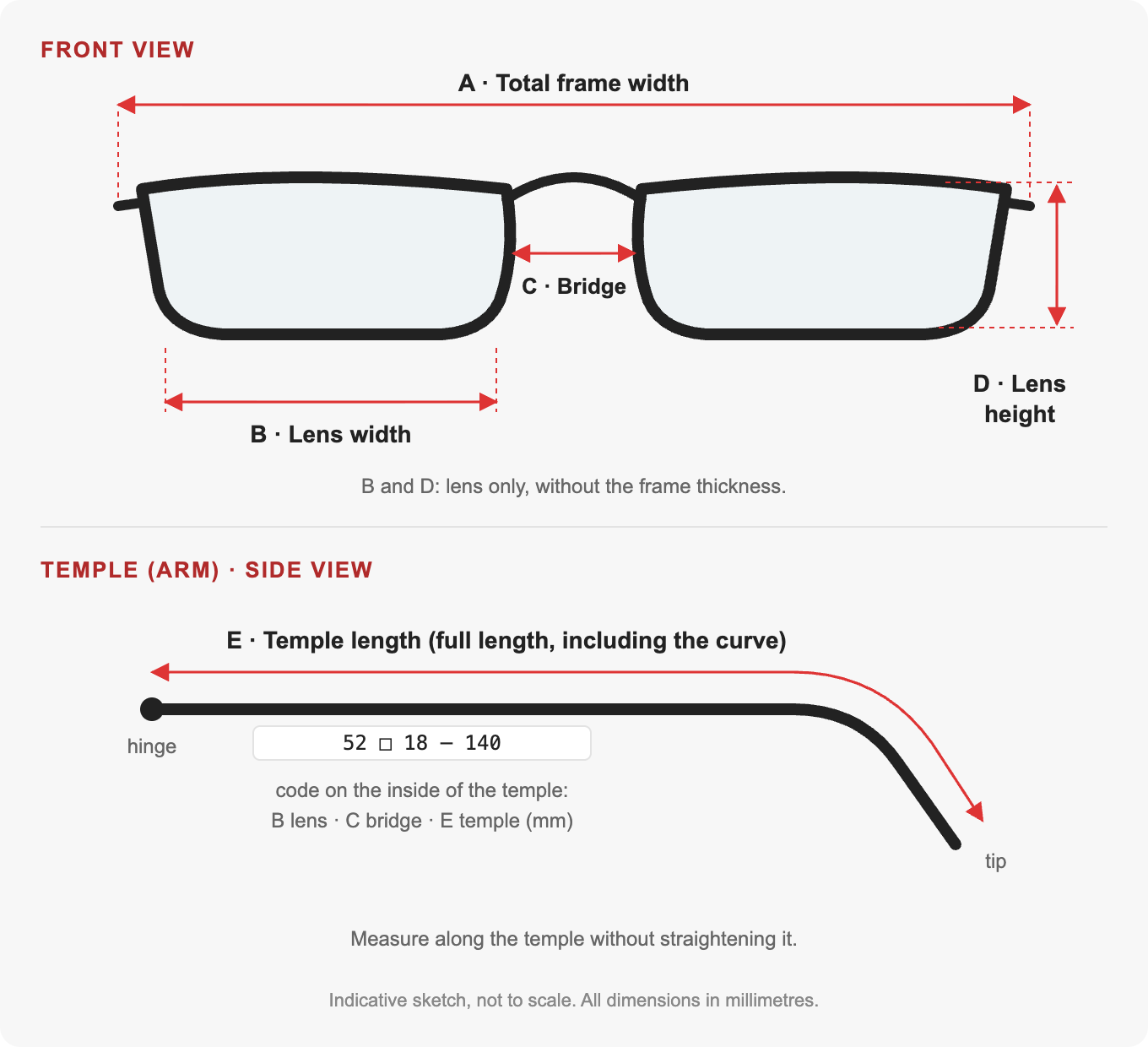
The quickest way: the code on the temple. Many frames have a code such as 52□18-140 printed on the inside of the temple. The first number is the lens width (B), the second is the bridge (C) and the third is the temple length (E).
If you measure with a ruler. Use a ruler marked in millimetres, and a tape measure for the temple. You can also use a piece of string and then measure it on the ruler. Do not stretch or bend the glasses.
Code | Name | How to measure |
|---|---|---|
A | Total frame width | With the glasses seen from the front, from the outer left edge to the outer right edge. |
B | Lens width | The widest part of one lens, without the frame. |
C | Bridge | The shortest distance between the two lenses, above the nose. |
D | Lens height | The tallest part of one lens, without the frame. |
E | Temple length | From the hinge to the tip, following the curved part as well. |
How to tell if they will fit
The total width (A) tells you the most about how the frame fits the width of your face. A difference of 2–3 mm from your current glasses is usually not noticeable.
The bridge (C) shows how the frame sits on your nose. Even 1–2 mm matter here.
The temple (E) fits if the difference is just a few millimetres.
When you try them on, the frame should sit steadily on your nose, without slipping or pinching. It should not press on your temples or behind your ears.
The dimensions are a guide: the shape of the bridge and the curve of the frame also affect comfort. If they still do not fit, you have 14 days to return them – see our Return policy.


