




















Presbyopia – why near vision gets harder after 40
Presbyopia is the gradual loss of the eyes’ ability to see clearly up close. It is not a disease but a natural, age-related change that affects almost everyone after the age of 40 [2][3][4]. The word comes from Greek and means “old eye” [2].
Why it happens
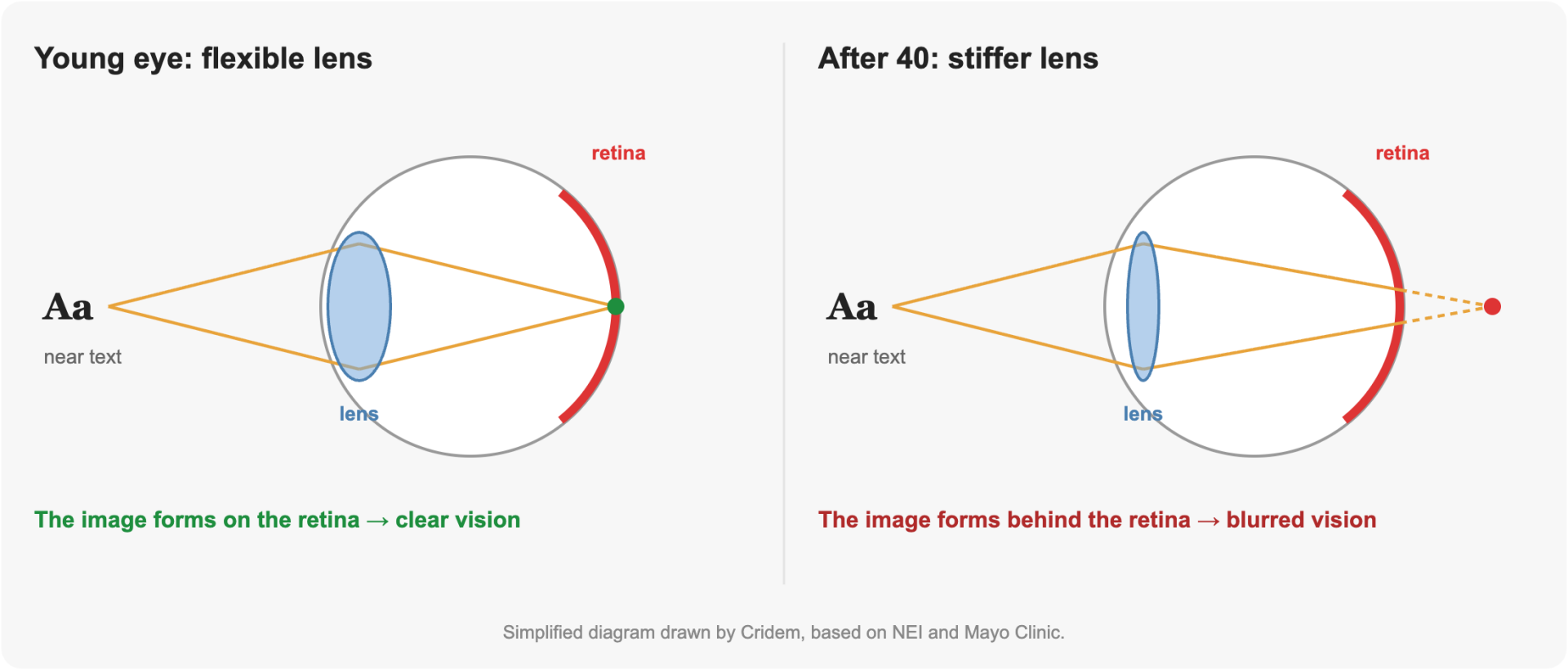
Inside the eye, behind the iris, sits the lens – a natural lens about the size of a small sugar-coated sweet [3]. In young people the lens is soft and flexible: a circular muscle makes it rounder when we look at something close and relaxes it when we look into the distance [3]. With age the lens hardens and loses its flexibility, so light from nearby objects no longer focuses on the retina but behind it [1][3][4]. That is why close-up text becomes blurred.
Presbyopia is different from farsightedness (hyperopia), even though both make near vision harder [1].
When it starts and how it progresses
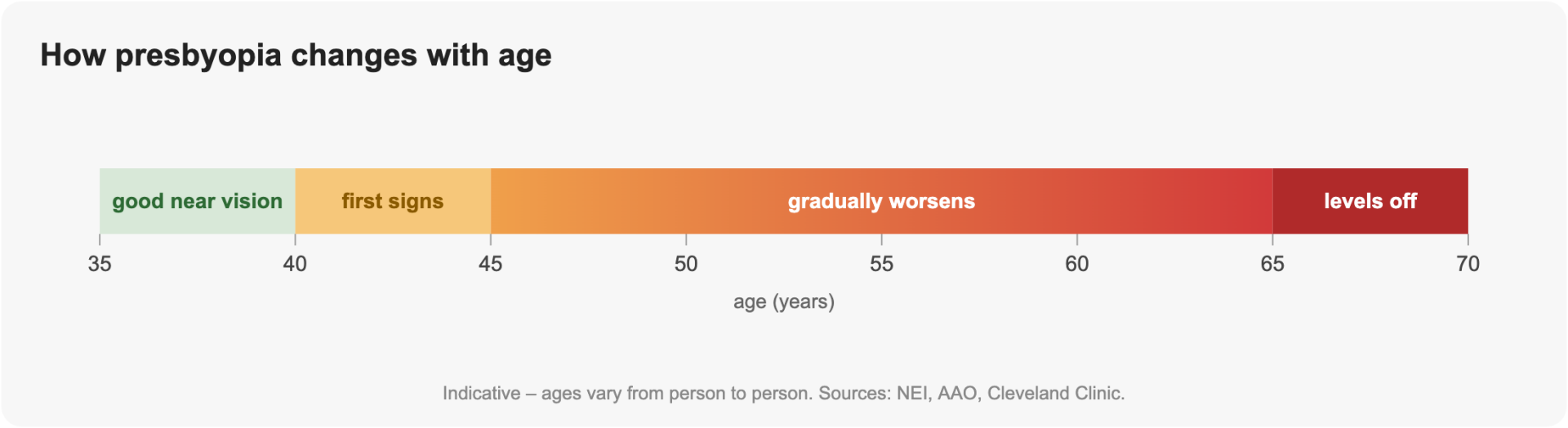
The first signs usually appear between the ages of 40 and 45 [1][2][5]. Although it may seem sudden, near vision declines gradually over several years [5]. Presbyopia worsens with age and generally levels off around the age of 65 [1][4]. This is why many people need stronger reading glasses every few years [5].
Common signs
You hold books, your phone or menus further away to be able to read [1][3].
Small print is blurred at your normal reading distance [3][4].
You need more light to read [4].
Your eyes get tired or you get headaches after reading or close work [1][3].
Who may develop presbyopia earlier
Age is the main factor. Presbyopia can also start before 40 in people with farsightedness, people with certain conditions (diabetes, multiple sclerosis, cardiovascular disease) or people taking certain medicines (for example antidepressants, antihistamines, diuretics) [3][4].
How it is diagnosed
Presbyopia is detected during a comprehensive eye examination, which is simple and painless [1][5]. During the same exam, the ophthalmologist or optometrist can also check for nearsightedness, farsightedness or astigmatism [4]. Most adults need an eye check every one to two years [4].
How it is corrected
Reading glasses – if you see well at a distance and only have presbyopia, reading glasses may be all you need [2]. They are available without a prescription, but the right strength is best determined at an eye exam [1][2]. For an indicative choice, see our guide How to choose the right reading glasses strength.
Bifocal, trifocal or progressive glasses – for people who also need distance correction [2][4].
Contact lenses – multifocal lenses or “monovision” (one eye for near, the other for distance); getting used to them can take up to two weeks [2][4].
Prescription eye drops (for example pilocarpine or aceclidine) – they make the pupil smaller and temporarily improve near vision for a few hours; use them only if recommended by a doctor [2][4].
Surgery – laser correction or replacing the lens with an implant; discuss this option with an ophthalmologist [2][4].
Presbyopia cannot be prevented or stopped, but it is easy to correct [2][4][5].
When to see a doctor
Book an eye exam if blurred near vision keeps you from reading, doing close work or everyday activities. See a doctor straight away if you have sudden loss of vision in one eye, sudden hazy or blurred vision, flashes of light, black spots, halos or double vision – these may be signs of more serious problems [3].
Important: the information on this page is general and does not replace an examination by an ophthalmologist or optometrist.
Sources
National Eye Institute (NIH, SUA) – Presbyopia
American Academy of Ophthalmology – What Is Presbyopia?
Mayo Clinic – Presbyopia – Symptoms and causes
Cleveland Clinic – Presbyopia: Symptoms, Causes & Treatment
American Optometric Association – Presbyopia
Sources consulted in November 2026. The numbers in brackets in the text refer to the sources above.


