






















Wheel Bolts, Nuts and Spacers: How to Choose the Right Fit

Wheel bolts, nuts, and wheel spacers
How to correctly choose the right wheel bolts, nuts, and spacers. Technical guide on threads, conical or spherical seating, and safe installation.
Key points
Fastener compatibility depends on thread pitch, effective length, wrench head size, and seat shape.
Using a spherical bolt on a rim with a conical seat is prohibited because it prevents proper fixation and can lead to the wheel loosening.
Alloy rims generally require longer assembly components with a different seating shape compared to steel rims.
Installing wheel spacers changes the vehicle's track width and requires the use of fasteners with an extended effective length.
Final wheel tightening must be done in a cross pattern using a torque wrench set to the manufacturer's specified torque.
What are the technical criteria for the compatibility of a bolt or nut?
Choosing the right wheel bolts for your rims depends on precisely identifying the technical parameters of the vehicle and the rim. Compatibility is not universal, and using unsuitable components directly affects driving safety. To determine perfect compatibility, the following parameters must be checked:
Thread: This is defined by the diameter and thread pitch (e.g., M12x1.25 or M14x1.5). An incorrect bolt thread will destroy the guide channel in the hub.
Seat shape: The contact area between the fastener and the rim can be conical (at a 60-degree angle, specific to many aftermarket rims) or spherical (rounded, used by car manufacturers such as Audi or Mercedes-Benz).
Effective length: This represents the threaded portion that penetrates the hub. An effective length that is too short does not provide the minimum number of full rotations for a secure fit, while one that is too long can block the mechanisms behind the hub.
Wrench head size: The external hexagonal size (such as a 17 mm or 19 mm head) must fit perfectly with your tool kit and the access space in the rim to prevent metal damage during installation.
In the Cridem catalog, there are options adapted to these technical requirements:
Seat type | Thread | Head size | Compatible product |
|---|---|---|---|
Conical 60° | M12x1.25 | 19 mm | 60° conical wheel bolts, 19 mm head, M12x1.25 thread, 50 mm thread length, 10 pcs. – TC5 |
Conical 60° | M14x1.5 | 17 mm | 60° conical wheel bolts, 17 mm head, M14x1.5 thread, 45 mm thread length, 10 pcs. – TC4 |
Spherical R12 | M12x1.5 | 17 mm | R12 spherical wheel bolts, 17 mm head, M12x1.5 thread |
Conical vs. spherical seat: how does head shape influence tightening safety?
The geometric difference between fasteners is critical for road safety, as incompatible profiles lead to loosening while driving. A conical seat is defined by a surface inclined at a precise 60-degree angle, while a spherical seat features a rounded shape defined by standardized radii, such as R12 or R14 profiles.
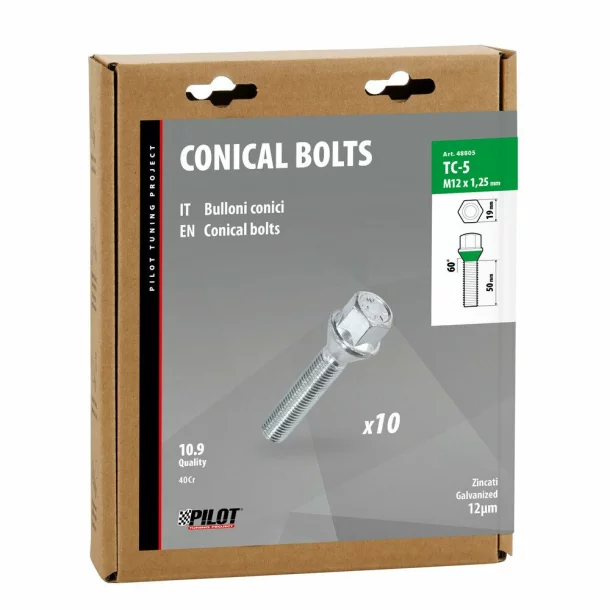
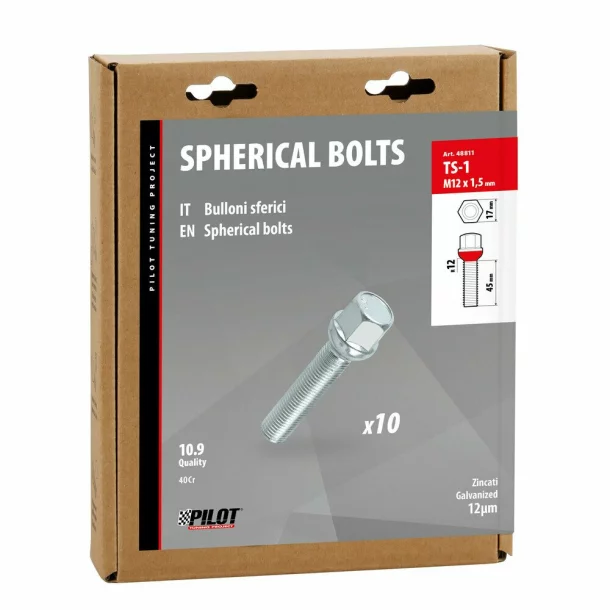
Accidentally installing a spherical bolt into a conical seat reduces the contact area to a simple circular line, preventing the uniform distribution of tightening force. This geometric mismatch generates vibrations and can lead to thread shearing or the wheel detaching while driving. For additional theft protection, nuts with special grooves or anti-theft bolt systems are used, which require a dedicated key for removal.
Seat type | Geometric profile | Main purpose | Contact mode with rim |
|---|---|---|---|
Conical | 60-degree right angle | Centering on rims with conical seat | Inclined flat surface |
Spherical | Round shape R12 or R14 | Fixation on rims with round seat | Molded curved surface |
Flat with washer | Flat shape | Fixation on rims with flat seat | Flat surface |
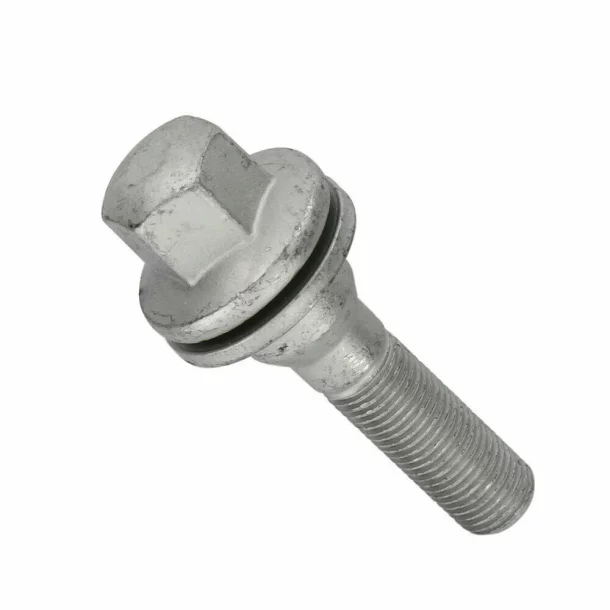
The correct choice of head shape is made exclusively based on the technical specifications of the rim used.
Why do steel and alloy rims require different fasteners?
The correct choice of fasteners depends directly on the material and structure of the rim used. Alloy rims have a structural flange that is considerably thicker in the mounting area compared to steel rims, which requires the use of assembly components with a longer effective length to ensure complete and secure threading into the hub.
The physical properties of the materials also dictate the geometric shape of the seat. While steel rims often use fasteners with a spherical or simple conical surface, aftermarket alloy rims require specifically adapted fasteners to distribute tightening force evenly over a larger surface. This adaptation is essential to prevent deformation or damage to the alloy, which is a softer material more sensitive to extreme point pressures than the steel of steel rims.
Rim type | Base material | Flange thickness | Seat shape | Configuration purpose |
|---|---|---|---|---|
Steel rim | Steel | Thin | Spherical, conical, or flat | Rigid fixation on narrow flange |
Alloy rim | Aluminum alloy | Thick | Conical, spherical, or flat | Pressure distribution on soft material |
Using unsuitable conical rim nuts or bolts intended for steel rims on an aluminum structure compromises wheel stability and can destroy the hub thread.
How does installing wheel spacers influence the length of the fasteners?
Installing wheel spacers modifies the vehicle's track width by interposing the flange between the hub and the rim, which requires the use of longer bolts to compensate for this additional thickness. To determine which wheel spacers you can install, it is essential to check their geometric compatibility based on the centering diameter and the original hub configuration.
Every millimeter added to the flange thickness must be reflected in the effective length of the fastener thread, thus ensuring the minimum number of full rotations required for a secure grip. Any installation that exceeds the vehicle's factory equipment requires official technical confirmation to allow for safe driving on public roads.
Installation type | Technical role | Required components | Safety requirement |
|---|---|---|---|
Original configuration | Maintaining factory track width | Standard bolts | Compliance with tightening torque |
With wheel spacers | Widening vehicle track width | Dedicated long bolts | Technical confirmation for public roads |
What does the notation for the distance between holes and the number of bolts represent?
The notation for the distance between holes and the number of holes represents the most important geometric compatibility criterion when purchasing new rims or fasteners. This indicator, known in technical literature as PCD (Pitch Circle Diameter), defines the diameter of the imaginary circle passing through the center of all wheel mounting holes. An expression like 5x112 indicates that the rim uses five mounting points arranged on a circle with a diameter of 112 millimeters.
Correct interpretation of these codes is essential to ensure perfect alignment of the rim on the car's hub. Even a minor deviation prevents correct centering, generating strong vibrations while driving and overloading suspension components.
Installation errors often occur due to millimeter differences between the construction standards of various car manufacturers, such as the fine difference between 5x110 and 5x112 configurations. To avoid these dangerous mismatches, identifying the exact hub size determines which accessories are needed. Depending on vehicle specifications, correct installation requires the use of conical rim nuts or rim bolts with an effective length adapted to the rim thickness and any wheel spacers used.
Tighten the wheel correctly: why are the cross pattern and torque wrench essential?
Correct installation of rims on the wheel hub depends directly on the tightening order and the precision of the applied force. To ensure a perfectly concentric and flat fit, wheel bolts or nuts must be tightened progressively using a cross or star pattern. This method prevents uneven tension and ensures that the rim is positioned correctly on the hub's seating surface, eliminating vibrations while driving.
Using a torque wrench is mandatory to apply the tightening torque specified by the vehicle manufacturer. Excessive tightening with pneumatic wrenches or improvised levers can deform the bolt threads, damage the rim seat, or lead to material cracking, while insufficient tightening endangers traffic safety due to the risk of the wheel loosening.
After driving the first few kilometers after installation, usually between 50 and 100 kilometers, it is essential to perform a preventive check of the tightening. Components can settle slightly under load while driving, and this quick check confirms that the correct torque is maintained and guarantees safe driving.
FAQ
How can I correctly measure the usable thread length I need for a wheel bolt?
The usable length is the threaded portion that actually enters the wheel hub. It is measured from the base of the seating surface (conical or spherical) to the threaded end of the wheel bolt.
Can I use conical wheel nuts on original wheels designed for a spherical seat?
No, using conical wheel nuts in spherical seats is strictly prohibited. The mismatch between the geometric shapes prevents even tightening, causing vibrations and creating a serious risk of the wheel coming loose while driving.
What changes when I choose wheel spacers for my car?
Installing wheel spacers increases the vehicle's track width and changes the position of the wheel relative to the fender. You must use longer wheel bolts, with the additional length equal to the thickness of the spacer, and check that the wheel is correctly centered on the hub.
Why is a torque wrench necessary for final wheel installation?
A torque wrench allows you to apply the exact tightening torque specified by the vehicle manufacturer. Overtightening can damage the thread or crack an alloy wheel, while insufficient tightening can compromise driving safety.


